THE END
THE END
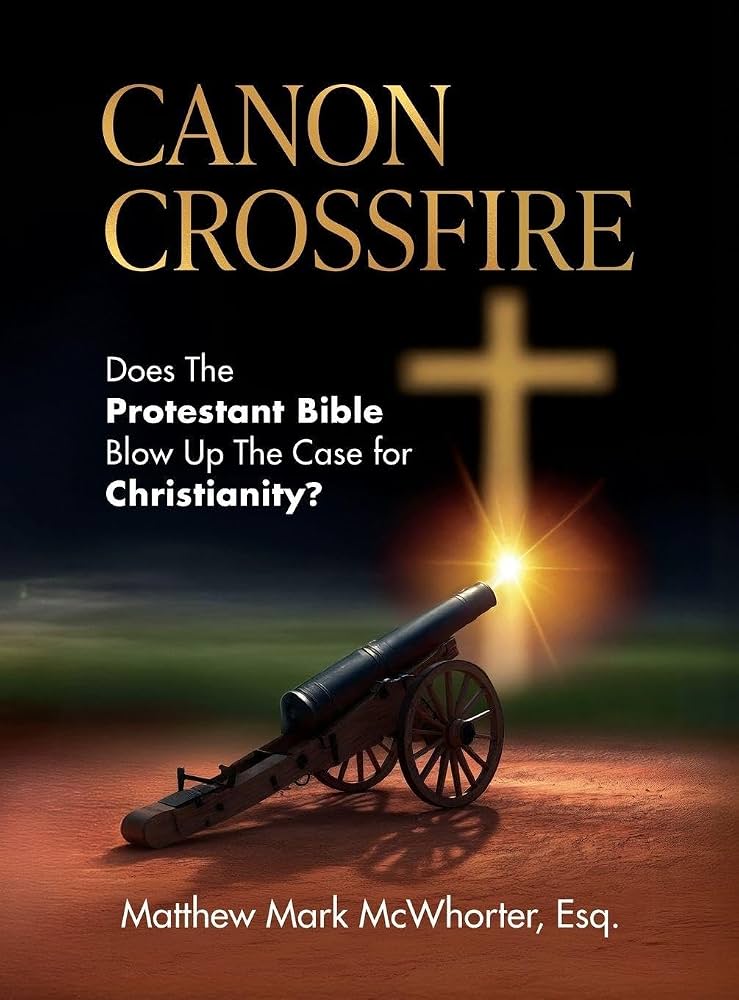
Author’s Note: Thank you for reading Canon Crossfire; whether you agree with my conclusions or not, I hope this book has encouraged you to examine the historical evidence with fresh eyes.
And that’s it. There was a flurry of competing lists from 350-400 AD. Toward the end of that period, two African Councils voted to accept all the Apocrypha, then everything stopped. The only lists anyone writes from 400 until 550 AD[1] are from (a) Pope Innocent I in 405 AD and (b) the second Council of Carthage in 419 AD (the one with 217 Bishops attending), both of which endorse the list approved at each of the two earlier African Councils: i.e., all the Apocrypha.
After that Council in 419 AD come 131 years of silence—a good five generations, as long ago now as 1895 is to me as I write this: the year of the first automobile race, the first American battleship, a ruling from the U.S. Supreme Court declaring that Congress and the U.S. federal government have no power at all under the Constitution to regulate manufacturing in any way, shape, or form.
Seems like a long time has passed.
During that 131-year period, the fifth century Great Uncial Codices are made—one with all the Apocrypha, and the other known to contain at least Wisdom and Sirach (with the rest of the Old Testament mostly missing).
Meanwhile, the number of sermons and treatises on the Apocrypha continued to grow after 400, as did citations to them as full Scripture.
I remind you that Kruger, when speaking on the New Testament, set forth the standard:
“… it took a while for the church to reach a consensus about all of these books. … there was no formal, official declaration of the church that closed the canon. …” (p. 286-287).
And that seems like a good place to end it.
[1] See, e.g., www.bible-researcher.com/canon8.html and biblecanon.org/lists/. Gallagher and Meade basically end with Pope Innocent I in 405 AD but with some much later additional material on ancillary topics (Codices, medieval manuscripts, Syriac canons, etc.).

I discuss the standard of consensus at https://read.canoncrossfire.com/sidebar-7-reasonable-standards-of-proof-part-iii/, and I discuss the Codex evidence at https://read.canoncrossfire.com/the-great-uncial-codices/ and https://read.canoncrossfire.com/great-uncial-codices/.