SIDEBAR 4: REASONABLE STANDARDS OF PROOF, PART I
SIDEBAR 4: REASONABLE STANDARDS OF PROOF, PART I
Author’s Note: This section introduces the evidentiary principles that will be applied consistently throughout Canon Crossfire when evaluating competing claims about the biblical canon.
Consider the Moslem view of Christianity. From Qureshi:
… Finally, we turn to the most common Muslim accusation against the Bible: that its text has been changed over time. It should also be clear now why Muslims accuse the Bible of having been altered: because the Quran says it teaches the same thing as the Bible, confirming the Torah and the gospel, yet the teachings of the Bible are clearly different. In the same vein, the Quran teaches that Muhammad was prophesied in the Bible, but there appears to be no such prophecy.[1]
How should we respond to such a claim? By asking Moslems to examine the evidence with an open mind, of course. I believe I could prove it to be wrong to any reasonable standard of proof. And that’s the key: they have to be open to a reasonable standard, a fair standard, an honest standard. Without that, the claims that there is “no proof” will never stop until the end of time.
But it is wrong for Christians to only ask Moslems and others to be open-minded. If we ask them to test their beliefs, we should be willing to submit our own to the same test. The case for Christianity is nothing but a showing that our religion passes the same test we expect others to judge their own beliefs by. Moreover:
Many proofs of Christianity can be shown, and proofs have been given over and over again. Evidences can be given, but is that the real issue? Do those who reject the Bible refuse to believe because the evidence is not convincing? As I said in the previous article, lack of information is not the problem. Nor is lack of evidence the problem. The reason for unbelief is simple. Unbelievers start from the presupposition that the claims of the Bible are not true.[2]
So if it is wrong for unbelievers to start with such a presupposition against Genesis, Isaiah, Psalms, Daniel, Jeremiah, and all the rest, it is also wrong for believers to start with such a presupposition against the Books of the Apocrypha. After all, as Lee Strobel’s Case for Christ tells us:
Judging for Yourself: Maybe you too have been basing your spiritual outlook on the evidence you’ve observed around you or gleaned long ago from books, college professors, family members, or friends. But is your conclusion really the best possible explanation for the evidence? If you were to dig deeper—to confront your preconceptions and systematically seek out proof—what would you find?[3]
And yet, for example, Josh McDowell, in The New Evidence that Demands a Verdict, builds his case upon his own biased presupposition, which seems to have blinded him to the unfair and inconsistent standards he used for judging the Apocrypha and the Protestant canon:
Jesus and the New Testament writers never once quote the Apocrypha, although there are hundreds of quotes and references to almost all of the canonical books of the Old Testament. (Emphasis added).[4]
That was on page 32 of my copy, after which follow more than 700 pages of evidence without a single mention of the Apocrypha (and the hundreds of references that are claimed to have been made to them in the New Testament, including many from Jesus Himself), but with innumerable mentions of references to the Books of the Protestant canon (e.g., that Jesus was alluding to Exodus and thereby claiming to be God when he said “I AM”).
However, if we are to take the case for Christianity seriously, then we must presume that (a) an opponent will object to any prejudiced double standard, and (b) a fair Judge will not allow the Christian to handwave away the opponent’s evidence, i.e., all the references to the Apocrypha. In fact, that some Christians “admit” that all the references to Apocrypha are not proof is exactly the opponent’s point: similar references should not be accepted as sufficient proof in the case made by such Christians either. And as we will see below, actual New Testament quotes of the Protestant canon are far fewer than is often realized, precisely because all Christians freely accept allusions, references, typology, etc. as sufficient proof without the slightest objection—unless the topic is the Apocrypha.
A related point involves all claims like these:
No other book outside of the Hebrew canon is ever cited with the formula, “Thus says the Lord,” “It is written,” or “Scripture says.” While some non-canonical writings may have been alluded to by the New Testament writers, these works are never quoted as Scripture or as having some sort of divine authority. This is further testimony that the extent of the Hebrew canon was clear to everyone at the time of Christ.[5]
This is a simple logical error, but do not take my word for it. From Norman Geisler and Thomas Howe, When Critics Ask: A Popular Handbook on Bible Difficulties, discussing another instance of the same logical error:
… there is an infallible mathematical rule that easily explains this problem: wherever there are two, there is always one — it never fails! Matthew did not say there was only one angel. One has to add the word “only” to Matthew’s account to make it contradict John’s [with two angels]. But if the critic comes to the Bible in order to show it errs, then the error is not in the Bible, but in the critic.[6]
In our case, this would be a logical error even if the New Testament quoted every Book of the Protestant canon (and it does not). So the situation is even more illogical, as I try to show visually below:
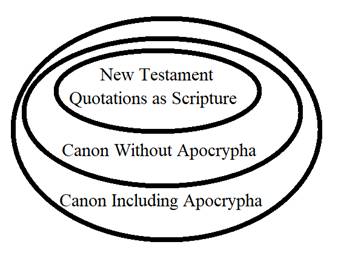
This claim is that the existence of the innermost circle proves that the Jews accepted “only” the second circle but not the third—which is nonsense.
To actually prove which circle is correct, we need to look at other evidence beyond just those three carefully hand-picked citation formulas. That inquiry should include (even emphasize) all the other evidence the Bible gives us. That no express statement from Jesus is made about the Apocrypha is no reason to then ignore all the other Biblical evidence.[7]
[1] No God But One, Zondervan 2016, p. 117.
[2] www.everlastingtruths.com/2016/02/26/do-people-not-believe-the-bible-because-of-a-lack-of-evidence/
[3] Introduction, page 21 of the Zondervan 2016 Edition.
[4] Citing to Norman L. Geisler and William E. Nix, A General Introduction to the Bible.
[5] www.blueletterbible.org/Comm/stewart_don/faq/right-books-in-old-testament/question17-new-testament-quote-old-testament.cfm
[6] When Critics Ask: A Popular Handbook on Bible Difficulties, by Norman Geisler and Thomas Howe, SP Publications, Inc. 1996, p. 21-22.
[7] There are further arguments one could make with Stewart over his three formulae, including that one such “Scripture says” reference (James 4:5, a “quotation” not found in the Protestant canon) may be an allusion to Wisdom 2:24. See more on that in the discussion of Wisdom, below.

Always consider what is a fair standard of proof – as also discussed in other “sidebar” chapters: https://read.canoncrossfire.com/sidebar-6-reasonable-standards-of-proof-part-ii/, and https://read.canoncrossfire.com/sidebar-7-reasonable-standards-of-proof-part-iii/.
The double standard on allusions is frankly ridiculous (and in fairness, I have never met a Protestant scholar who tried to argue against the existence of allusions to the Apocrypha or their use and value as evidence – which is not the same thing as saying that they appreciate how that evidence looks to those who do not start with a presupposition against the Apocrypha). For examples of the double standard, consider just Stewart’s own discussion of “quotes” from the New Testament to the Pentateuch (see https://read.canoncrossfire.com/hebrews-1135-to-2-maccabees-77/#:~:text=Pentateuch%20Reference%20(from%20Stewart)), where Stewart repeatedly claims allusions are “quotes” and valid proof that Jesus and the Evangelists accepted the Five Books of Moses. But even more, Jews and skeptics can argue that your alleged Old Testament prophecy does not prove anything either, as discussed at https://read.canoncrossfire.com/statistical-analysis-of-the-1611-kjv-cross-references/.