
STATISTICAL ANALYSIS OF THE GOSPEL TO THE JEWS
STATISTICAL ANALYSIS OF THE GOSPEL TO THE JEWS
Author’s Note: This analysis of the Gospel of Matthew asks what Scriptures the first Jewish Christians were most likely to have accepted and how that evidence informs the canon debate.
There were 115 New Testament cross-references with Apocrypha in the original 1611 KJV.[1] According to the KJV, there were zero such cross-references with the Gospel of Mark, five with the Gospel of John, and 14 with Luke. According to the KJV, there were 22 cross-references between the Apocrypha and the Gospel of Matthew—more than for the other three Gospels combined.
In other words, according to the KJV, there were more cross-references between the Gospel to the Jews and the Apocrypha than for all the other three Gospels combined. After all, “[i]t is quite obvious and widely accepted that Matthew was written to the Jews.”[2] The Evangelical Biblical Theology Commentary on Matthew (written by Charles L. Quarles, Chair of Biblical Theology at Southeastern Baptist Theological Seminary) provides more detail:
the Gospel was originally addressed to assemblies that still participated in temple rituals, … observed the Sabbath …and perhaps Jewish dietary laws…, and were in conflict with the Pharisees and their scribes … Eusebius … states that Matthew wrote the Gospel for the Hebrews to whom he had previously preached in order to compensate for his absence after he left to carry the gospel to other nations…[3]
Craig S. Keener, past president of the Evangelical Theological Society, notes that modern scholars believe that Matthew used Mark as a starting point (over half of Matthew seems to have been copied from Mark[4]):
Where possible, Matthew has made Mark’s Jesus “more Jewish.” That is … Matthew has consistently re-Judaized Jesus for his Jewish audience… Matthew is Jewish, in dialogue with contemporary Jewish thought and skilled in traditional Jewish interpretation of the Old Testament…. Matthew’s Jewish readers would have been more familiar with the traditional prophetic perspective…[5]
As part of “re-Judaizing” Jesus, he who was “skilled in traditional Jewish interpretation of the Old Testament” and was writing to “Jewish readers more familiar with the traditional prophetic perspective” may have referred to Apocrypha more than the other three Gospels combined.
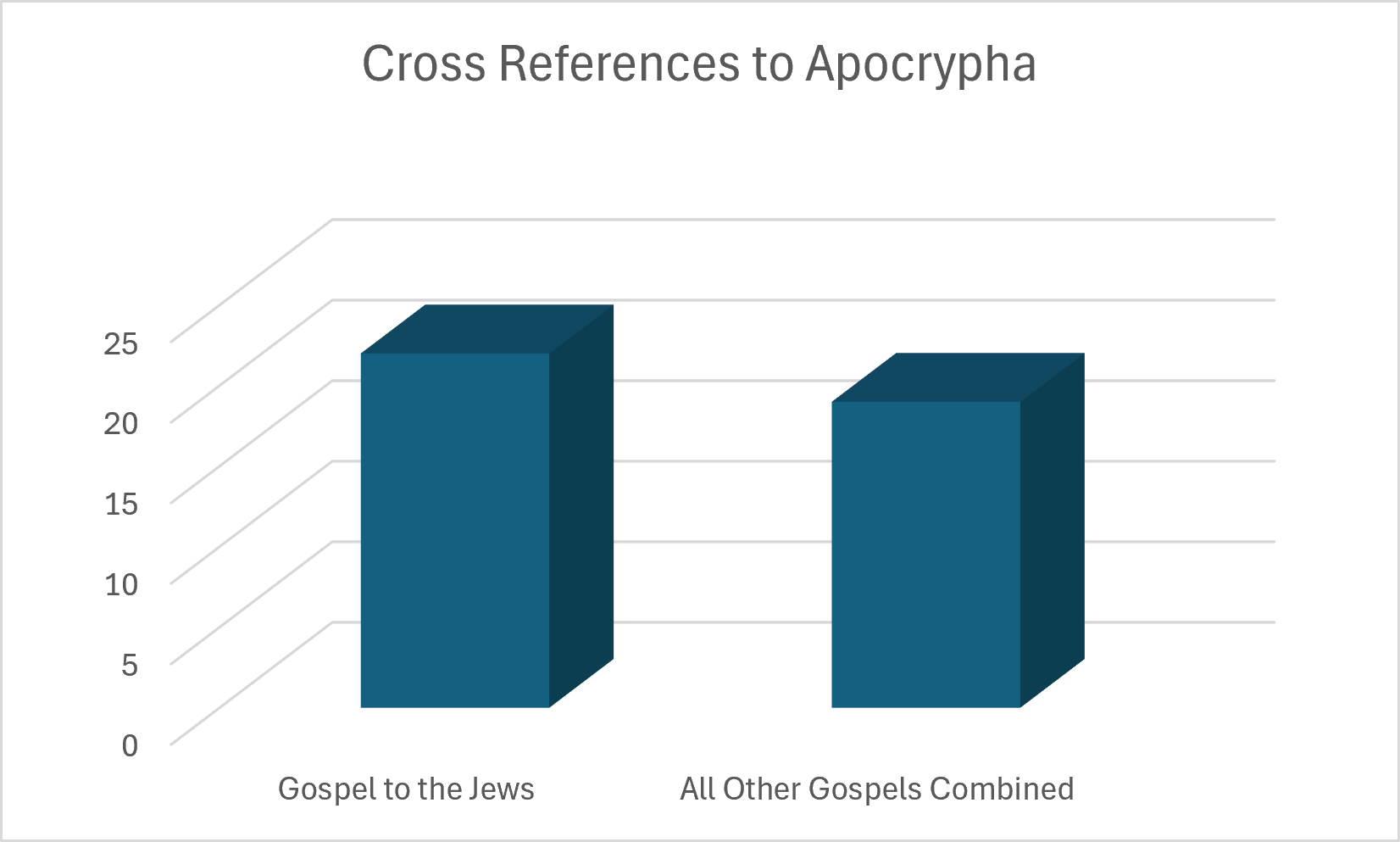
Since a majority of Matthew parallels Mark, in essentially less than half a Gospel of additional material, Matthew has a staggering 22 KJV cross-references to Apocrypha.
All this was added to a book (the Gospel of Mark) that, according to the KJV, originally had no cross-references at all. Recall that the Gospel of Mark includes many notes to explain Judaism to its audience: “For the Pharisees, and all the Jews, except they wash their hands oft, eat not … And many other things there be, which they have received to hold, as the washing of cups, and pots, brasen vessels, and of tables.” (Mark 7:3-4). Matthew started with Mark and its notable lack of focus on Jews, then added many possible references to the Apocrypha—as part of a Gospel directed to the Jews, many of whom were converted Jewish Priests (Acts 6:7).
Edward Hindson (Dean of the Institute of Biblical Studies at Liberty University and one of the translators of the New King James Version of the Bible) and James Borland (a fellow professor at Liberty University) note that:
The Gospel of Matthew is the most Jewish of all the Gospels. In its inspired pages … Matthew … writes to Jewish believers and unbelievers alike. … It was the perfect bridge to the Old Testament and the ideal introduction to the New Testament … it is saturated with 130 references to the Hebrew Scriptures, emphasizing that Jesus is the fulfillment of the prophecies and types of the Old Testament.[6]
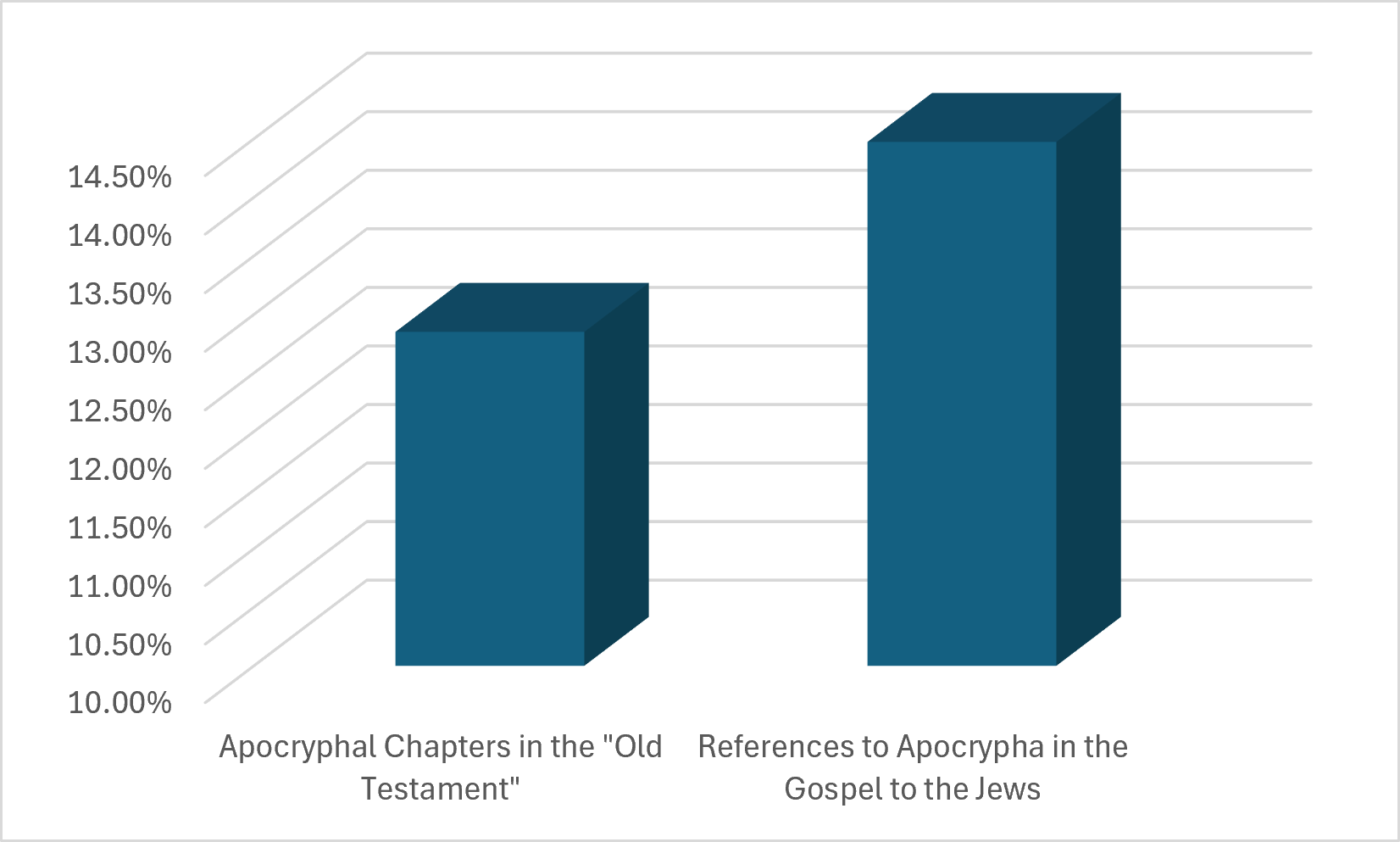
It is also saturated with 22 cross-references with Apocrypha.[7] The Protestant Old Testament has 929 chapters, to which the Catholic version adds 137, for a total of 1066. The 137 extra chapters account for 12.85% of the chapters in the Catholic Old Testament. The 22 cross-references with Apocrypha added to the 130 references for the Protestant canon equal 152 references. 14.47% of the references to the “Old Testament” in the Gospel to the Jews were to the Apocrypha: by this combined metric, the Apocrypha may have been referenced even more often than the Protestant Old Testament was.
I would note that not a single Apocrypha cross-reference in the 1611 KJV occurs in the genealogy of Jesus, whereas 14 cross references to the Protestant canon (in the 1611 KJV) are just references in the genealogy. So, substantively, it would seem that the focus on Apocrypha in the Gospel to the Jews is even more pronounced than the comparison initially indicates.
…Matthew …quotes the fulfillment of Old Testament prophecies… Further, Matthew assumes that his readers understand Jewish prophecies, festivals, and traditions, clearly indicating his intent to persuade Jewish readers … (p. 3).
Judging from the KJV, the Apocrypha were a key part of those Jewish prophecies and traditions. They were also a key piece of Matthew’s “intent to persuade Jewish readers,” when Matthew was writing the “perfect bridge to the Old Testament and the ideal introduction to the New Testament.”
[1] I counted these things by hand. The references were mentioned in either or both of the KJV comments to the New Testament or their comments to the Apocrypha.
[2] www.blueletterbible.org/study/intros/matthew.cfm.
[3] Lexham 2022, p. 25 and 33.
[4] https://en.wikipedia.org/wiki/Synoptic_Gospels
[5] In the IVP New Testament Commentary Series volume on Matthew 1997, p. 21-22, 32, 34.
[6] Twenty-First Century Biblical Commentary, Matthew, AMG Publishers 2007, p. xi, 1.
[7] I own numerous KJV Bibles but none that claim to be the “New KJV” and also include references to Apocrypha. So, this comparison is of the old KJV for the Apocrypha and the new KJV for everything else. We must not make too much of the particular numbers in this comparison because it is apples to oranges, but I think it is worth discussing.

Beyond the numbers, consider also how deep and meaningful are the allusions Matthew makes. E.g., read what Protestant scholars have to say about just the allusions Matthew made to the Book of Wisdom alone, such as https://read.canoncrossfire.com/matthew-2743-to-wisdom-218/, https://read.canoncrossfire.com/matthew-1522-to-wisdom-720/, https://read.canoncrossfire.com/matthew-2213-to-wisdom-1721/, and https://read.canoncrossfire.com/matthew-1119-30-to-wisdom-910-etc/.